AI Workflows: How Businesses Are Embedding AI Into Everyday Operations
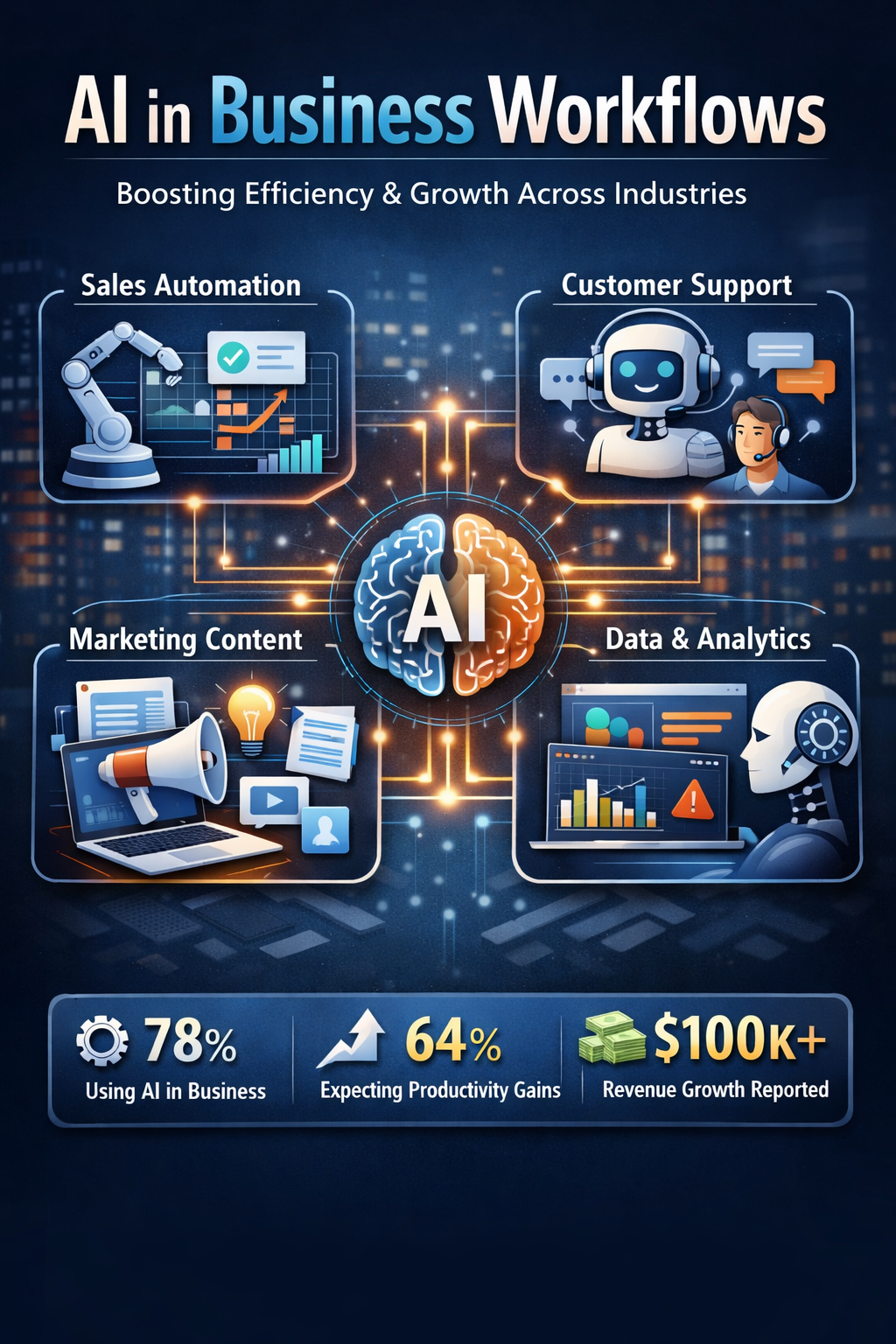
Artificial intelligence is moving from experimental tools to embedded workflows that quietly power everyday business operations. Instead of prompting chatbots, organizations are redesigning processes so AI handles repetitive steps and supports decision-making in real time by analyzing and presenting data. Research shows this shift is accelerating. A recent global survey found 78% of organizations now use AI in at least one business function, a significant increase from 55% just a year earlier. At the same time, leaders increasingly see AI as a driver of productivity and growth. In one survey, 64% of businesses said AI will increase overall productivity in their operations.
When implemented strategically, AI workflow automation can increase conversion rates and create measurable revenue impact.
What an AI Workflow Actually Is
An AI workflow is not just a single AI tool. It is a chain of automated steps where AI performs specific tasks within a larger process, often connected to other software systems.
Example structure:
Data enters the system (form, CRM, ticket)
AI analyzes or generates
Automation tools route the output
Humans review or approve if needed
System logs results and triggers next steps
This kind of orchestration allows organizations to scale work that previously required large teams.
Scenario 1: AI-Driven Sales Pipeline Automation
Problem:
Sales teams spend significant time researching leads, writing outreach messages and logging CRM data.
AI Workflow looks like this: lead submits form on website, AI evaluates lead quality and intent through a variety of sources, CRM automatically enriched with company data and AI drafts personalized outreach email. The sales rep reviews and sends, following up with a phone call. AI summarizes call notes and updates CRM.
Scenario 2: Customer Support Automation
Problem:
Support teams handle thousands of repetitive inquiries.
AI Workflow looks like this: Customer message arrives via chat or email. AI categorizes the request and generates an initial response. Low-complexity requests are resolved automatically while complex issues escalate to human agents with AI-generated summaries.
Modern platforms report 40–60% of support queries can be resolved by AI agents alone, reducing support load and improving response time.
Scenario 3: Marketing Content Production
Problem:
Marketing teams must constantly produce blog posts, social content, emails and campaign assets.
AI Workflow looks like this: Marketing manager inputs campaign goals, AI generates content drafts with company branding kit, SEO tools optimize keywords and structure, the final product is reviewed and edited by the team. Automation schedules distribution across channels, and finally analytics tools feed campaign results back into AI for optimization
This dramatically reduces the cycle time for campaigns while enabling teams to scale content output.
Scenario 4: Operations and Internal Decision Support
Problem:
Managers must sift through large datasets to make operational decisions.
AI Workflow looks like this: business data feeds into analytics tools that are AI enabled. AI detects trends, anomalies, and patterns that are sent to managers. This alerts to risks or opportunities. AI can also generate recommended actions. Studies show AI improves enterprise decision-making by accelerating analysis and increasing the amount of data that can be included. It reduces human error in data interpretation, leading to faster and more evidence-based management decisions.
This is a very broad workflow that is very customizable depending on the sector and the goals of the company.
Best Platforms for Building AI Workflows
These are real platforms that I have incorporated into businesses with success.
1. Zapier
One of the most accessible automation platforms for businesses. It connects thousands of apps and can integrate AI tools into existing processes.
Typical used for lead qualification, marketing automation and customer support routing.
2. n8n
A powerful low-code automation platform often used for more advanced workflows and self-hosted automation pipelines.
Case studies show workflow automation platforms can reduce task execution time from minutes to seconds while eliminating manual errors.
3. AI-native enterprise platforms
Examples include AI-enabled CRM and support tools that integrate directly with organizational data systems.
These platforms combine AI assistants, workflow automation, analytics dashboards and integrated enterprise data.
The Strategic Lesson: AI Success Is About Workflow Design
The biggest difference between companies seeing real results from AI and those stuck in experimentation is workflow redesign.
Consulting research shows only a small percentage of organizations are currently capturing significant value from AI.
A learning architect or instructional designer plays a critical role in helping organizations successfully integrate AI into their workflows. Rather than focusing only on the technology, they analyze how work actually happens. This could mean identifying performance gaps, decision points and repetitive tasks where AI can add value. They then design structured workflows, training resources and support systems that help employees use AI tools effectively within real business processes. By aligning AI capabilities with human expertise and clear learning goals, learning designers help organizations move beyond experimentation and toward measurable improvements.