
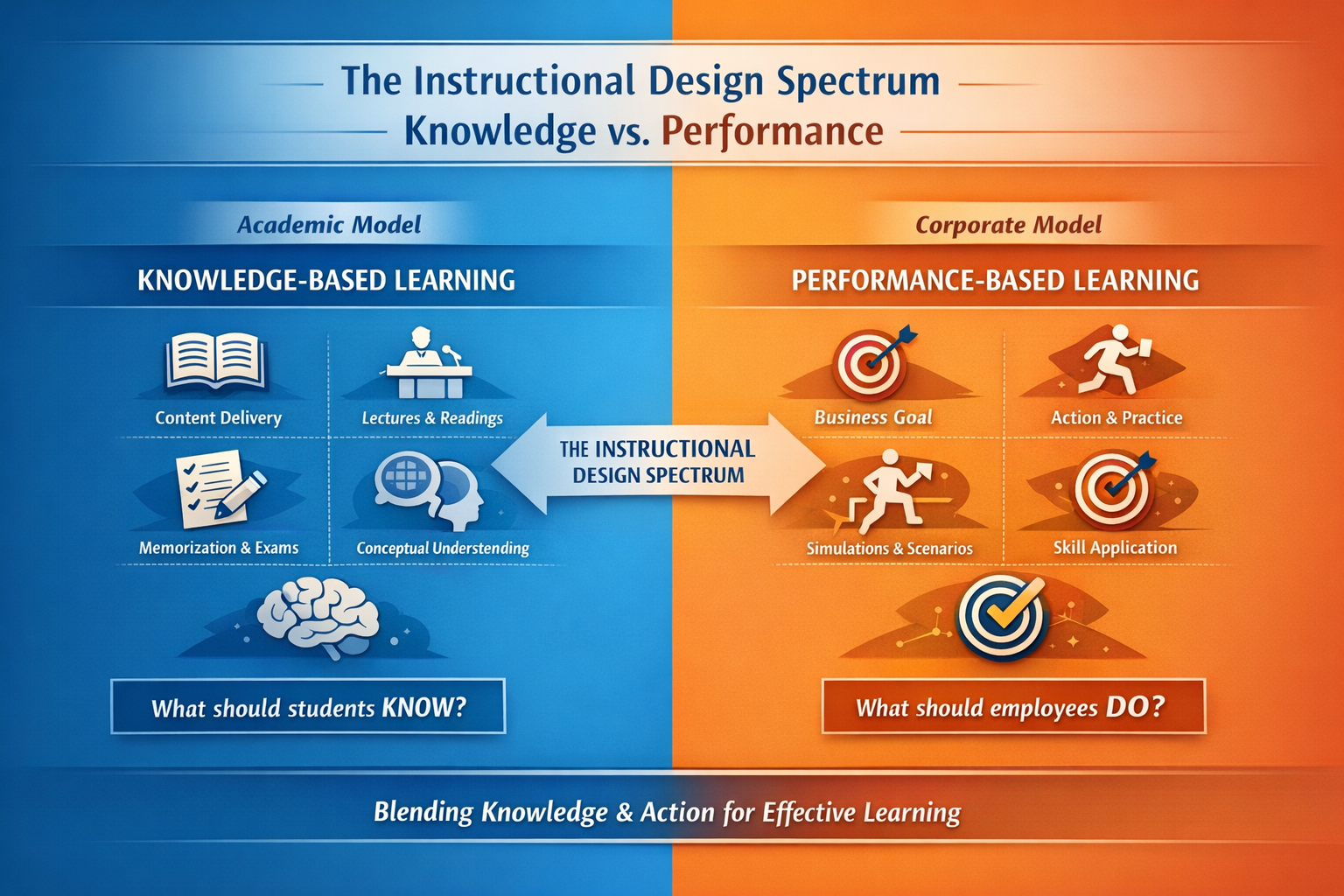
Instructional design exists in two very different ecosystems: the corporate world and academia. Both care deeply about learning, but they often start from completely different assumptions about what learning is supposed to accomplish. In the corporate world, instructional design is typically driven by performance outcomes. The question is simple: What should people be able to do after this training?
In academia, learning experiences are more often designed around knowledge development. The guiding question becomes: What should students understand after this course? Both approaches have value. But when designers move between these environments, as I often do, the contrast becomes striking.
The Corporate Approach
Action Mapping and Performance Outcomes
In corporate learning one of the most influential design approaches is Action Mapping, developed by instructional design expert Cathy Moore. Action Mapping flips the traditional training design process on its head. Instead of starting with content, it starts with a performance problem.
The process typically follows four steps:
Identify the business goal
What measurable outcome does the organization want to improve?Define the critical behaviors
What must employees do differently to reach that goal?Design realistic practice activities
How can learners practice those behaviors in safe, simulated situations?Provide only the information needed to support the action
In this model, information is not the centerpiece of learning, it’s a support tool. For example, if a company wants to reduce customer complaint escalations, the training goal is not “understand conflict resolution theory.” Instead, the goal is for employees to successfully de-escalate a frustrated customer during a call. This goal doesn’t require a traditional course presenting information, instead it uses learning activities like branching scenarios, decision-based simulations, role-play exercises or rapid feedback loops.
The key question is always: “Can the learner perform the target behavior?” If the answer is yes, the training succeeded.
The Academic Model
Knowledge Preparation
In universities and schools, instructional design tends to focus on building conceptual understanding and disciplinary knowledge. Courses are frequently structured around readings, lectures, discussions, written assignments and exams. The central goal is not always immediate performance. Instead, it is often knowledge preparation by helping students build mental frameworks that may support future expertise.
This model makes sense in many academic contexts. For example, a chemistry course may need to teach atomic theory and apply it to thermodynamics and equilibrium principles. Students may not immediately perform these concepts in a workplace setting. Instead, they are building foundational knowledge that enables later problem solving and scientific reasoning.
Academic learning prioritizes conceptual depth, theoretical frameworks, disciplinary literacy and long-term intellectual development The question guiding design becomes: “What should students know and understand by the end of the course?”
Where the Two Models Clash
The tension between these approaches often becomes visible when graduates enter professional environments, myself included. A common complaint in corporate settings is: “New employees know the theory, but they can’t actually do the job yet.” From a corporate perspective, this can feel like a failure of training. From an academic perspective, however, that was never the primary goal of the course. Universities are preparing students to think like historians, scientists, engineers or writers, not necessarily to perform a specific workplace task on day one. Both perspectives are valid, but distinct in their final goals.
Bridging the Gap
Performance-Informed Education
Some of the most exciting work in instructional design today sits at the intersection of these two models. Educators are beginning to incorporate elements of performance-based design into academic learning environments. Activities like scenario-based learning, problem-based instruction, case studies and simulations and authentic assessment tasks are starting to be incorporated into classrooms because the research shows how effective they can be. These approaches move beyond knowledge recall and ask students to apply their learning in realistic situations.
For example, instead of simply explaining a chemistry concept, students might be asked to design an experiment, interpret real experimental data, or troubleshoot a failed reaction. These tasks begin to mirror the decision-making processes scientists use in real research environments and in other words, they bring Action Mapping thinking into academic design.
Why This Matters for Instructional Designers
Instructional designers who understand both worlds gain a powerful advantage. Corporate learning teams want designers who can tie learning directly to business outcomes, create measurable performance improvements and design practice-driven learning experiences. At the same time, education systems are beginning to recognize that knowledge alone does not guarantee capability. Students need opportunities to practice decision-making, problem solving and applied reasoning. Designers who can integrate academic rigor with performance-based learning design can build experiences that do both and help learners not only understand ideas, but also use them effectively.
A Personal Reflection
As both a classroom educator and a corporate instructional designer, I find myself constantly navigating this divide. In my own teaching, I try to design learning experiences that move beyond content delivery toward applied scientific thinking. Students don’t just learn chemistry concepts, they practice using those concepts to analyze data, explain phenomena and solve unfamiliar problems. And while the goal isn’t to turn school into job training, it is to recognize that learning becomes powerful when knowledge and action intersect.
Final Thought
Training exists to change behavior.
Deep knowledge takes time to build.
The future of instructional design may lie in blending these perspectives by creating learning experiences that develop understanding while also preparing learners to act.
