A Learning Designer's Guide to Effective Compliance Training
Compliance Training: Traditional vs. Effective
When employees see "Annual Compliance Training" appear in their inbox, the collective groan is inevitable. As learning designers, we've inherited a legacy of hour-long modules, dense policy reviews and training that tries to cover everything while actually accomplishing very little. And with the technology and tools available to us now, these types of training shouldn’t exist anymore.
I've spent years working on compliance training programs, and I've learned something fundamental: more training doesn't equal better compliance. In fact, the opposite is often true. The organizations seeing the best compliance outcomes aren't the ones with the most comprehensive training libraries, they're the ones who've learned to be strategic and relentlessly practical in their approaches.
What Works
The Case for Targeted Training
One of the biggest mistakes I see organizations make is deploying identical compliance training to everyone. A lab technician handling biological materials has vastly different compliance needs than someone in marketing or finance. Yet we often put them through the same four-hour course covering regulations that may never apply to their role. We can fix this by making role specific compliance pathways all within the same training program.
This means that before training even happens, learning designers will begin by mapping specific compliance requirements to job functions, eliminating content that doesn't directly apply to the learner's daily work and then reating modular content that can be assembled into relevant learning paths. When training is directly connected to what employees actually do, their engagement increases dramatically. People pay attention when they recognize their own work scenarios on screen. They tune out when they're watching content about processes they'll never touch.
The question I always ask stakeholders: "If an employee can't apply this information in their role, why are we asking them to learn it?"
Reducing Cognitive Load
The key to making training that translate to specific actions or behavioral changes is to always keep cognitive load theory in mind and active in practice. Our working memory can only hold so much information at once. When we overload compliance training with every policy detail, exception and edge case, we're essentially guaranteeing that employees will forget most of it before they return to their duties.
So, design for the essential, not the exhaustive.
This means:
1) Identifying the 20% of information that drives 80% of compliant behavior
2) Stripping away nice-to-know content in favor of need-to-know
3) Using clear, simple language instead of regulatory jargon
4) Breaking complex topics into digestible segments
For high-stakes environments like biotech, this approach might feel counterintuitive. Covering everything superficially is far more dangerous than covering critical points thoroughly. When everything is emphasized, nothing is remembered.
Scenario-Based Training and Simulations
People don't retain compliance procedures from reading policies. They learn by navigating situations. Scenario-based training transforms passive content consumption into active problem-solving. Instead of telling employees, "Always verify documentation before proceeding," we put them in a simulation where incomplete documentation appears and they must decide how to respond. The emotional engagement of making a decision as well as seeing consequences play out, creates memory anchors that policy documents and slide decks cannot.
For organizations where feasible, simulations take this further. In biotech and pharmaceutical settings, virtual lab environments can allow employees to practice proper procedures without risk. In corporate settings, branching scenarios can simulate difficult conversations around conflicts of interest or data handling. The goal is to create a safe space to fail, learn and build the judgment muscles needed for real situations.
Job Aids, Reference Sheets and Other Always-Available Resources
Training events are moments while compliance is ongoing. One of the most impactful shifts I’ve made over the past few years in my approach has been recognizing that people don't need to memorize everything but they do need to know where to find it. This means building a robust support ecosystem of reference sheets that distill key procedures into scannable formats, job aids positioned at the point of need (digital or physical), searchable knowledge bases for quick answers (AI is great for this), and live support channels where employees can ask questions when situations are ambiguous.
The goal of training isn't to fill heads with information, it's to build enough foundational understanding that employees can recognize compliance-relevant situations and know how to find the right answer. For eLearning specifically, this means always linking to support resources, making them accessible within workflows and normalizing "looking it up" as the professional behavior it is.

Postable job aid available on accuform
The 10-Minute Rule
Here's my working principle: employees should spend no more than 10 minutes per workday on compliance training and reinforcement activities. This also means that compliance training can be required for ten minutes everyday IF the data supports the need for it.
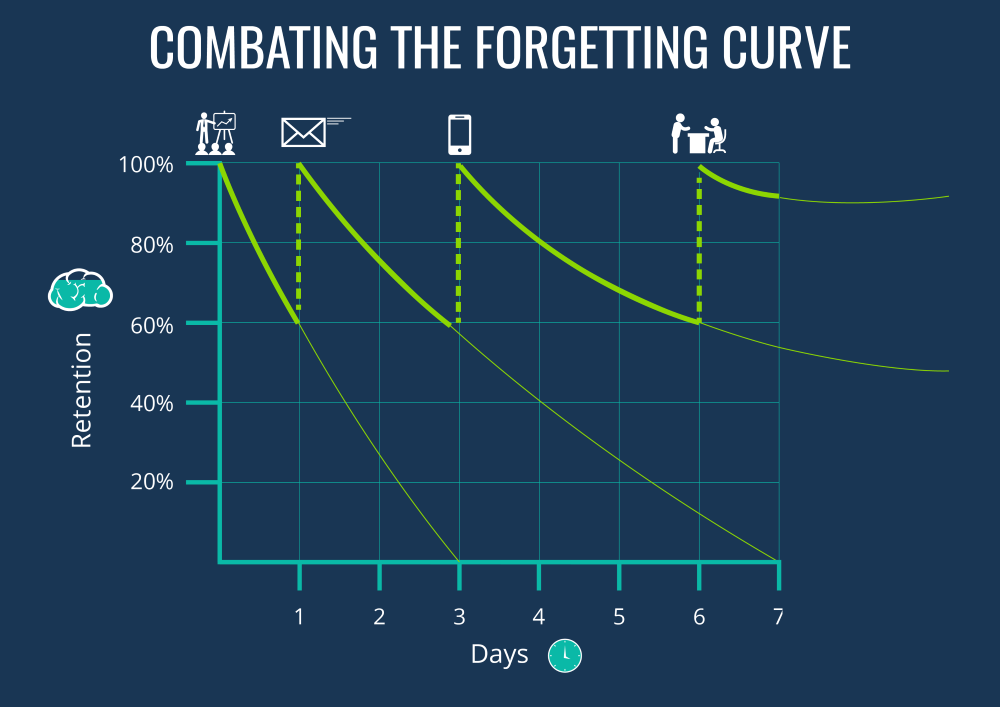
The Forgetting Curve by Ebbinghaus
We aren’t doing arbitrary training, we are recognizing that primary duties must remain primary and attention spans are finite. Research overwhelmingly supports that frequent, short exposures beat infrequent, long ones for retention. In practice this can look like daily (or every other day) scenario checkpoints. These are brief, periodic scenarios that take no more than 2-3 minutes and are embedded into daily workflows. Clock in, check your email, do your scenario, then attend to primary duties.
These scenarios keep information fresh and give you data on where understanding might be slipping. These focused bursts of content revisit key concepts before memory decay can set it. And if it has already been forgotten? Targeted microlearning can be assigned immediately and completed in 5 minutes. This accommodates for learners who need more interaction with the material before it is officially mastered.
This approach doesn't just improve retention, it fundamentally changes the relationship employees have with compliance training. It becomes a normal part of the work rhythm rather than an annual disruption.
Data-Driven Relearning
When compliance gaps emerge, the instinct is often to retrain everyone. Mandatory refreshers get pushed out, and employees who already mastered the content sit through material they don't need while those who are struggling get lost in the crowd. With the LMS systems and technology available you should use your data to personalize relearning. Modern learning platforms can identify which individuals are struggling with specific concepts, which scenarios produce the most incorrect responses and where knowledge is decaying over time. When we have this information, we can deploy targeted microlearning refreshers to those who need it and ONLY those who need it. This respects the time of high performers while ensuring struggling employees get additional support. And those high performers who are not in training are left doing what benefits the company the most: the primary duties they were hired for.
The final result is a more efficient use of training resources, better compliance outcomes and employees who know the organization values their time and skills.
Bringing It All Together
Effective compliance training is about strategic design that recognizes how people actually learn and respecting the demands of their primary roles. I love building systems that incorporate ongoing reinforcement.
The core principles that I design around are:
1) Make it relevant to the individual's actual work
2) Reduce cognitive load to essential information
3) Use scenarios and simulations to build real judgment
4) Provide robust support materials for point-of-need access
5) Reinforce in brief, frequent intervals
6) Use data to target relearning to individuals who need it
When we get this right, compliance training becomes a strategic asset that is efficient, effective and genuinely protective of both the organization and its people.
That's the compliance training program worth building.
